Showing posts with label cuburr. Show all posts

Friday, August 2, 2013

Puzzle Party: IPP33 Opens


When I arrived in Japan for the International Puzzle Party many other puzzlers had already been there for quite some time, and they'd been out sightseeing and visiting.  I joined a small group of friends on an unofficial trip to visit a few puzzle sights, including (pictured above) George Miller, Roxanne Wong (wearing my ivy cap) and her daughter Katherine, and Naoki Takashima.

First we visited Takafumi Haseda, who operates the Tribox puzzle store online.  The store operates in a residential apartment converted into an office, a photo studio, and a stockroom packed with puzzle merchandise.  Pictured, Andreas Nortmann (too tall!), Roxanne, and Takafumi venture into the stock room search for hidden treasures.

Next we trekked to the office of Hanayama, the maker of the world's finest mass-produced brainteaser puzzles.  Above, Oskar van Deventer and his wife discovered a sign that greeted his arrival outside the Hanayama office.

A room at Hanayama displayed their huge assortment of Japanese toys and games, in addition to their world renown collections of cast puzzles.

Our next destination would have been Puzzle Shop Torito, but the shop was scheduled to be closed for a few days.  So we went sightseeing to the 2080-foot-high Tokyo SkyTree.

From the SkyTree we observed a puzzling building that exhibited an illusion like an MC Escher painting: the green roof appears to wrap around the two elevator towers in the center of the building, but the elevetor towers clearly connect to the green roof at different floors!

There's a glass floor for intrepid visitors willing to stand on thin air over 1000' above ground.

Back at the hotel, Dirk Weber successfully solved my Twisty Trillion puzzle.


Hanayama Puzzles exhibited a fascinating display that showed how many of their most famous puzzles evolved before they went into production.

My favorite entry in the 2013 Design Competition was Bram Cohen's Galaxy, which won a jury prize.  It went on to be manufactured by Hanayama Puzzles, widely sold by puzzle stores like Puzzle Master.

Thursday, July 21, 2011

Flexible Burr...Cuburr?

Here's a picture of the current revision of my flexible burr puzzle. I've adopted a scheme with a distinct color for each type of part.


Assembling the parts depends heavily on the flexibility of the material, as the parts must be distorted to fit through each other.


It looks like a mess, but the puzzle is almost solved.


The last step is to fold the faces flat and hook the corners together so it holds a cube shape.


I carved the puzzle's name "Cuburr" into one of the faces in the 3D data, which caused the SD300 to trace it like line art.


That last trick exploits a limitation of the SD300's build process: in the STL data the letters were rendered as cutouts in flat wall, narrower than 1 mm. The SD300's XY plotter can cut with 0.1mm precision, but regions narrower than 1 mm are left bonded to the layer beneath; you have to pry them mechanically if you want them removed. For situations like this, it's a convenient way to emboss line art onto a flat surface.

Thursday, July 14, 2011

A flexible burr puzzle

(7 Feb 2013) I notice some debate about this post elsewhere online -- if you have questions feel free to leave a comment or contact me via the email address in my profile (right).

 
In 2002 George Miller devised an unusual puzzle titled Three Card Burr, made by laser cutting slots into three ordinary playing cards so they could be interlaced together. Interestingly, there's no practical way to disassemble the cards after the puzzle has been solved.


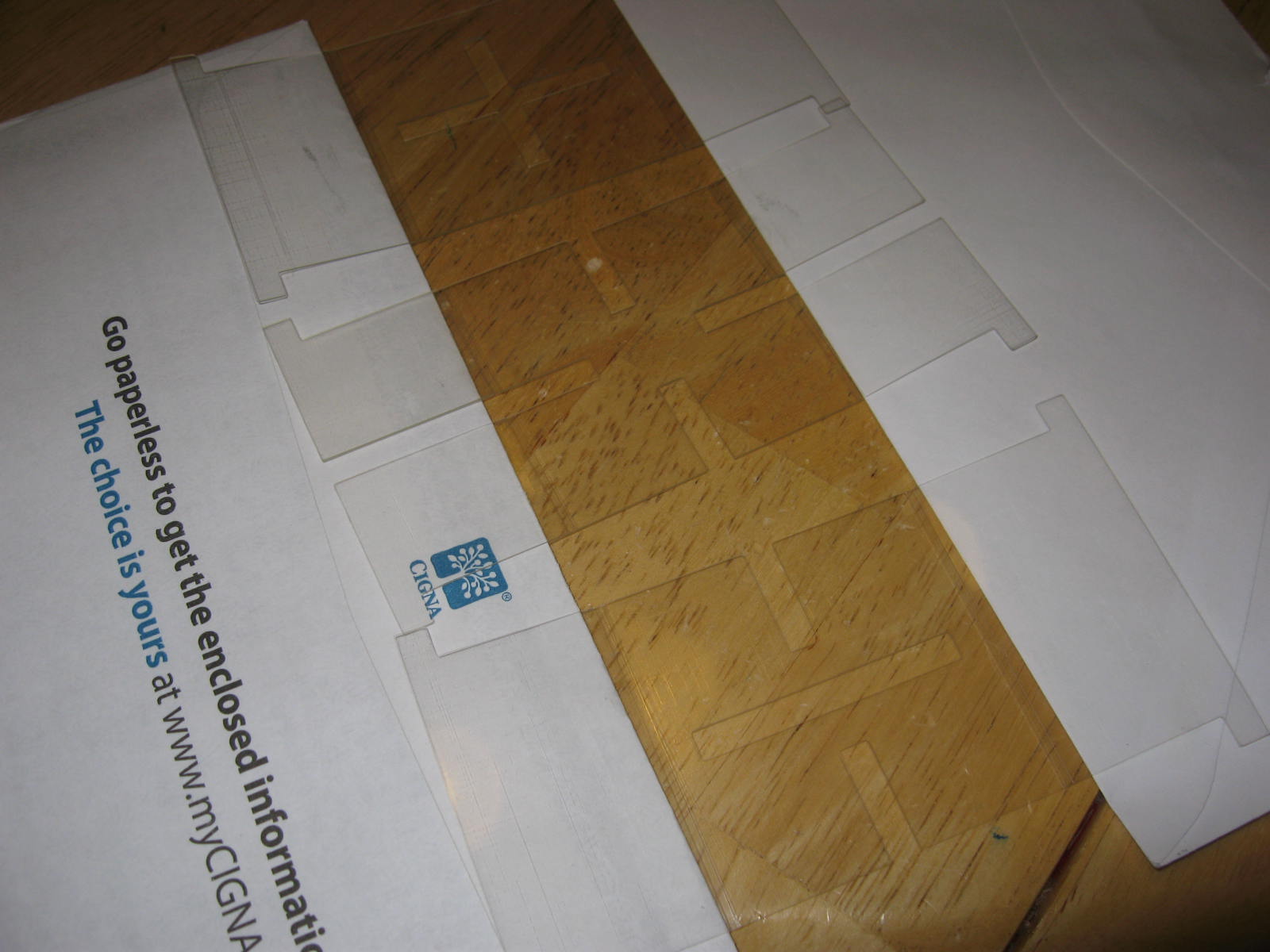
I was inspired by George Miller's Three Card Burr puzzle to create a more complex puzzle to exploit the SD300's ability to build sheet-like structures by creating a 3D model whose geometry can be mapped to the build material. I designed this flat model whose middle section is nominally 0.51mm thick, so it will be built using three thicknesses of 172-micron PVC sheet. The adjacent areas have two 0.34mm thick panels stacked one above the other and attached to the middle section by a 0.17mm thick strip to act as a hinge. The whole model is about 120mm x 70mm x 0.9 mm.


Here are my first 3 sample models, built in transparent material.


Like Three Card Burr assembling the puzzle begins by carefully interlacing the sheets together. It wasn't as difficult as I'd expected because the resiliency of the PVC material enabled me to flex the puzzle without tearing it.


Once the pieces are interlaced together, the hinged panels fold out and interlock at the corners to form a cube. This part was far more difficult than I'd expected because each corner depends upon its neighbors for stability, which meant each corner would come apart when I tried to assemble the next corner. I'd forgotten to allow for the thickness of the material in the corner dimensions, so the panels warped from excess tension.


Not bad for a first try, though. It proves the concept is basically sound; now I just have to adjust the dimensions and add something to make the corners more stable. Maybe a small tab or hook?